




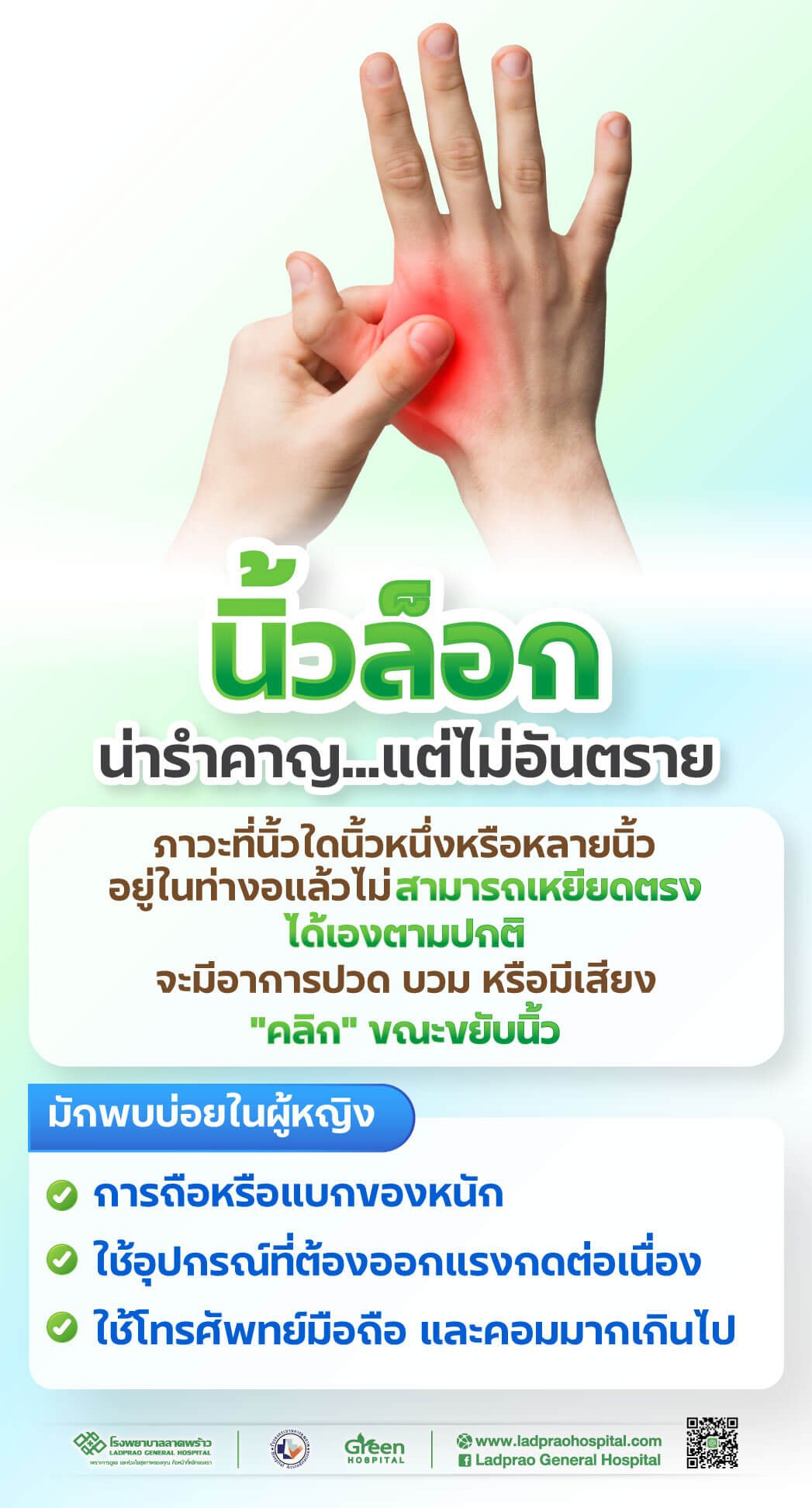
» Trigger finger
- Also known as Stenosing Tenosynovitis, this condition occurs when one or more fingers are bent and unable to straighten normally. The condition can cause pain, swelling, or a "clicking" sound when the fingers are moved.
» Cause.
- The main reason for the lock fingers is that tendons used in bending fingers become inflamed and thickened, as well as the narrowing of the ligament casing, preventing the tendons from moving smoothly through the ligament casing. This is often caused by people who work hard or do activities that require repeated finger strain for a long time, such as:
- Typing all day led to a repetitive strain injury in my wrists.
- Some occupations, such as craftsmen, carpenters, hairdressers, or gardeners.
- People who play certain sports, such as golf and tennis.
- Other health conditions, such as diabetes, rheumatoid arthritis, or gout.
» Symptoms.
- Symptoms of trigger finger can be divided into different stages as follows:
- Initial stage: Pain at the base of the finger, especially in the morning. A small, hard lump may be felt at the base of the finger and is painful when pressed.
- Stage 2: The finger begins to jerk or twitch when moved, especially when extending the finger. A “clicking” sound may also be heard.
- Stage 3: The finger is locked in a bent position and cannot be straightened on its own. The other hand must be used to help straighten it.
- Stage Four: The finger is frozen in a bent position and cannot be straightened even with the help of the hand.
» How to treat.
- Treatment for trigger finger depends on the severity of the symptoms, with several options available.
- Rest: Avoid activities that require heavy hand and finger use, and avoid clenching or flexing your hands for a period of time.
- Hot compress: Apply warm compress to the base of the finger to help reduce pain and relax the muscles.
- Medication: Your doctor may prescribe pain relievers and nonsteroidal anti-inflammatory drugs (NSAIDs) to relieve your symptoms.
- Steroid injection: This is a popular treatment for early to mid-stage tendonitis. The doctor will inject a steroid medication only at the base of the finger to reduce inflammation of the tendon sheath.
- Surgery: In severe cases or when other treatments have failed, your doctor may consider performing a minor surgery to open the narrowed tendon sheath so that the tendon can move normally.
For further inquiries, please contact the Orthopedic Center, 4th Floor, Building 3, at 0 2530 2556 ext. 3400 or 3401