




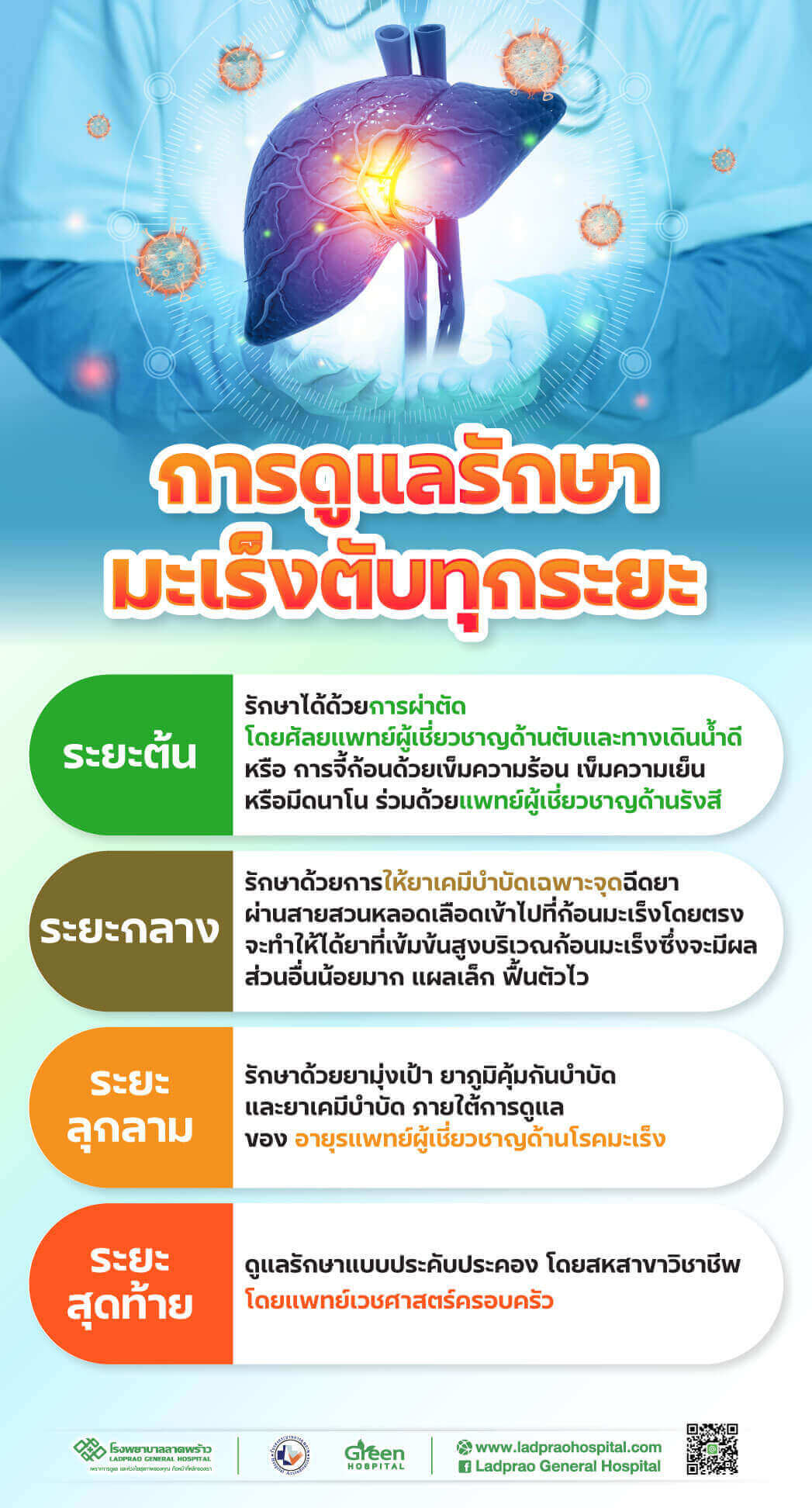
» General guidelines for the treatment of liver cancer at each stage.
- Early stage liver cancer (stage 1-2)
- At this stage, the cancer is still small and has not spread to other parts of the liver or nearby organs. The main goal of treatment is to completely eliminate the cancer cells, giving the patient the best chance of a complete cure.
- Surgical removal of the cancerous part: This is the best method if the tumor is small, in an easily accessible location for surgery, and the patient is in good health.
- Liver transplant: This is another option for some patients whose tumor is small but whose remaining liver is not functioning well or has cirrhosis.
- Ablation: Radiofrequency Ablation (RFA) or Cryoablation is the use of radiofrequency waves to directly destroy the cancerous tumor. It is often used in cases where the tumor is small but cannot be operated on.
- At this stage, the cancer is still small and has not spread to other parts of the liver or nearby organs. The main goal of treatment is to completely eliminate the cancer cells, giving the patient the best chance of a complete cure.
- มะเร็งตับระยะกลาง
- เป็นระยะที่มีก้อนมะเร็งหลายก้อน แต่ยังจำกัดอยู่ภายในตับ และยังไม่ลุกลามเข้าเส้นเลือดใหญ่ การทำงานของตับยังดี ผู้ป่วยมีสุขภาพแข็งแรง
- การให้ยาเคมีบำบัดผ่านทางหลอดเลือดแดงที่ไปเลี้ยงก้อนมะเร็ง (TACE – Transarterial Chemoembolization): เป็นการฉีดสารเคมีบำบัดร่วมกับสารอุดหลอดเลือดเพื่อจำกัดการไหลเวียนของเลือดไปเลี้ยงก้อนมะเร็ง ทำให้เซลล์มะเร็งตาย
- การให้สารกัมมันตรังสีผ่านทางหลอดเลือดแดงที่ไปเลี้ยงก้อนมะเร็ง (TARE/SIRT): เป็นอีกทางเลือกของการรักษาเฉพาะที่
- เป็นระยะที่มีก้อนมะเร็งหลายก้อน แต่ยังจำกัดอยู่ภายในตับ และยังไม่ลุกลามเข้าเส้นเลือดใหญ่ การทำงานของตับยังดี ผู้ป่วยมีสุขภาพแข็งแรง
- Advanced liver cancer.
- When the cancer becomes larger, involves multiple tumors, or begins to invade blood vessels, doctors will use treatments that focus on controlling tumor growth to extend the patient's lifespan and improve their quality of life.
- Transarterial Chemoembolization (TACE): This involves injecting chemotherapy drugs and an embolizing agent directly into the artery supplying the tumor. This cuts off the tumor's blood supply and allows the medication to destroy the cancer cells.
- Targeted Therapy: This treatment uses drugs that specifically target cancer cells, causing them to die with fewer side effects on healthy cells compared to traditional chemotherapy.
- Radiation therapy: Uses high-energy radiation to destroy cancer cells. It can also be used to relieve pain from cancer that has spread to the bones.
- When the cancer becomes larger, involves multiple tumors, or begins to invade blood vessels, doctors will use treatments that focus on controlling tumor growth to extend the patient's lifespan and improve their quality of life.
- End-stage liver cancer.
- At this stage, the cancer has spread extensively to other organs. The primary goal of care therefore shifts to palliative care, which aims to relieve pain and other unpleasant symptoms, allowing the patient to have the best possible quality of life. รักษาแบบประคับประคอง (Palliative Care) To control the various symptoms arising from the disease and side effects from treatment, allowing the patient to feel as physically and mentally comfortable as possible.
- Symptom management: Doctors will provide medication to alleviate various symptoms such as pain, nausea, vomiting, ascites (fluid in the abdomen), or fatigue.
- Encouragement and mental health care: Providing supportive conversations with patients and their families is very important. It helps patients feel they are not alone in facing their illness and gives them the strength to live their lives in the remaining time.
- Nutritional support: Choosing easily digestible foods suitable for the patient's condition, such as soft foods or medical supplements, can help reduce nausea and provide essential nutrients to the body.
- At this stage, the cancer has spread extensively to other organs. The primary goal of care therefore shifts to palliative care, which aims to relieve pain and other unpleasant symptoms, allowing the patient to have the best possible quality of life. รักษาแบบประคับประคอง (Palliative Care) To control the various symptoms arising from the disease and side effects from treatment, allowing the patient to feel as physically and mentally comfortable as possible.
You can ask for more information at Gastrointestinal and Liver Center, Building 3, 2nd Floor, Tel. 0 2530 2556 ext. 3210