




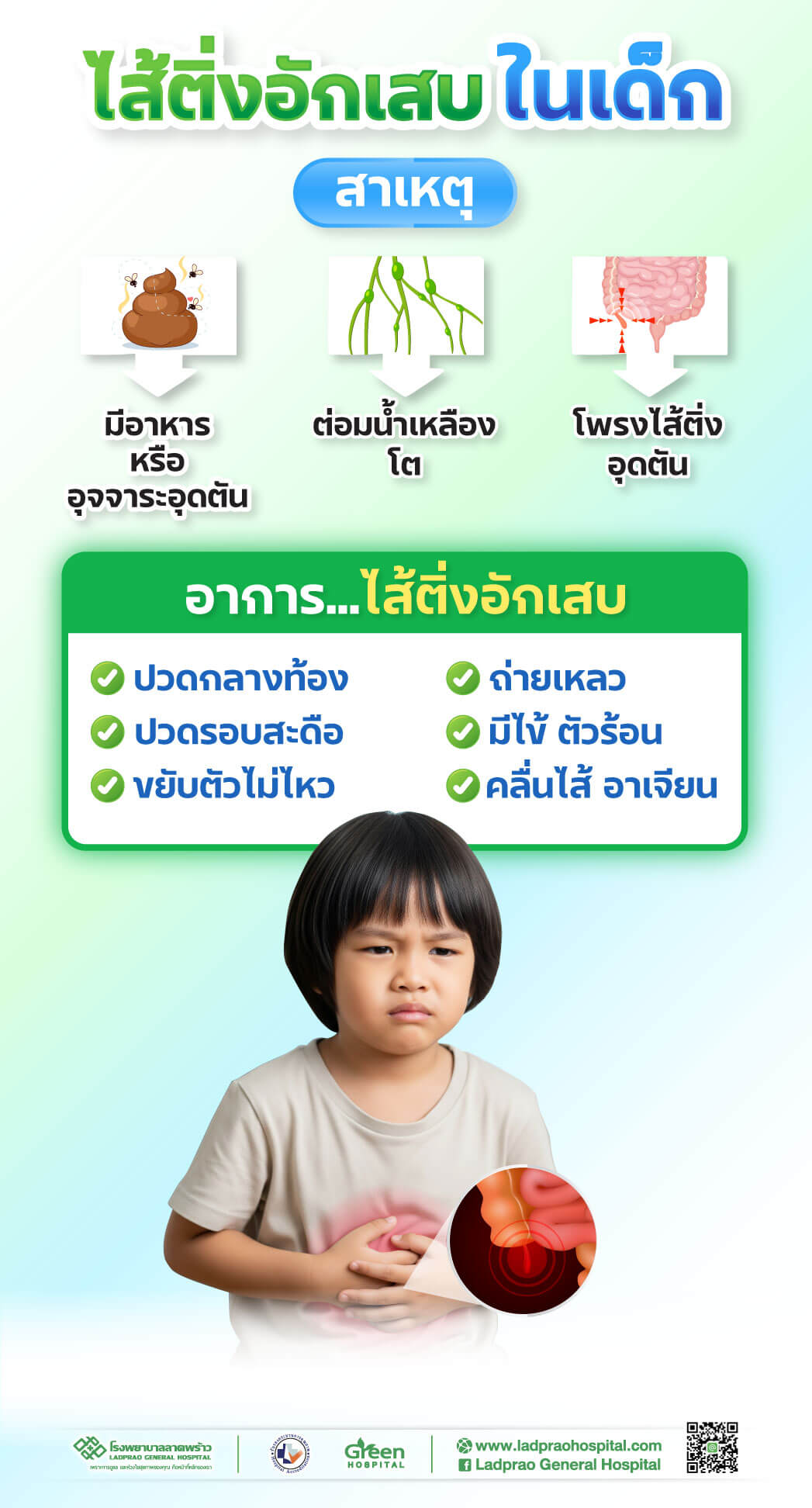
» Appendicitis in children
- This is a dangerous condition that requires a rapid diagnosis and treatment. A child's appendix has a thinner wall than an adult's, making it more likely to rupture. This can lead to serious complications such as a peritonitis (infection of the abdominal cavity) or sepsis (bloodstream infection), both of which can be life-threatening.
» Symptoms that should be noted
- Signs of appendicitis in children may not be as obvious as in adults, so parents must monitor them closely, especially young children who cannot communicate clearly. Common symptoms include:
- Abdominal pain.
- In older children: The pain often starts as a dull ache around the navel and then moves to the lower right abdomen, where it becomes constant.
- In younger children: The child will be fussy and cry more than usual due to the abdominal pain. Some may double over in pain, and if you press on their lower right abdomen, their muscles will tense up and they will show signs of discomfort.
- Other symptoms.
- Loss of appetite, refusing to drink milk or eat food.
- Nausea vomiting.
- Fever, which is a clear sign of inflammation.
- Bloating.
- Diarrhea.
- If your child's abdominal pain worsens with movement and doesn't improve after vomiting or having a bowel movement, you should suspect appendicitis and seek immediate medical attention.
- Abdominal pain.
» Cause.
- The main cause of appendicitis is the obstruction of the appendix lumen, which can be caused by.
- Hardened stool: Fecaliths (hardened pieces of stool) fall into the appendix lumen and cause an obstruction.
- Swollen lymph nodes: Lymph nodes at the base of the appendix become swollen and press on the appendix lumen.
- Worms or other foreign objects.
- Kinking or bending of the appendix itself.
- When an obstruction occurs, it causes inflammation and infection inside the appendix. If left untreated for too long, the appendix's blood supply will be cut off and it may rupture.
» Diagnosis and treatment.
- Diagnosis: A doctor will take a medical history and perform a physical examination, specifically by palpating the lower right abdomen. In addition, further tests may be conducted, such as a blood test to check for an elevated white blood cell count, and a radiological examination like an ultrasound or a CT scan.
- Treatment: The primary treatment is the surgical removal of the appendix (an appendectomy), which can be performed in two ways:
- Open Appendectomy: The doctor will make an incision in the abdomen to remove the appendix.
- Laparoscopic Surgery: This is the most common method today because it involves smaller incisions, which leads to a faster recovery and a shorter hospital stay of only one to two days.
For more information, please contact the Pediatric Center, Building 2, 2nd Floor, Tel. 0 2530 2556 ext. 2200, 2201.